
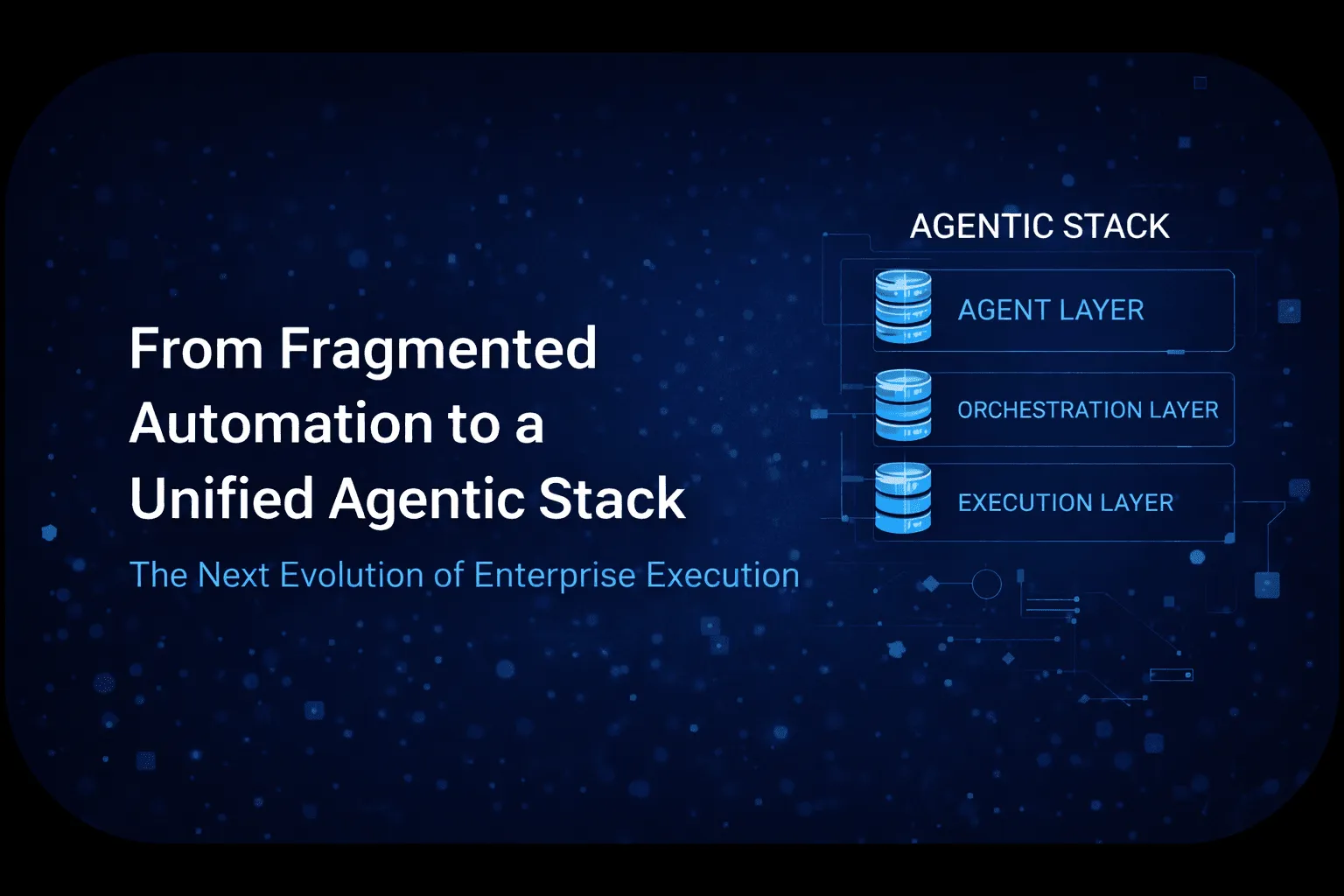
From Fragmented Automation to a Unified Agentic Stack: The Next Evolution of Enterprise Execution
Introduction
For years, enterprises have chased automation through a patchwork of tools—RPA bots for repetitive tasks, AI models for predictions, and workflow engines to stitch processes together. While each layer added incremental value, the overall system became increasingly fragmented, brittle, and difficult to scale.
Today, that approach is breaking.
A new paradigm is emerging—the Unified Agentic Stack—where AI Agents don't just execute tasks, but reason, orchestrate, and adapt across systems in real time.
The Problem with Fragmented Automation
Most enterprise automation stacks today look something like this:
- RPA tools handling UI-based tasks
- AI/ML models operating in silos
- Workflow engines managing logic
- Manual interventions bridging gaps
While functional, this architecture creates serious challenges:
- High maintenance overhead due to multiple disconnected systems
- Limited adaptability when processes change
- Poor scalability across complex workflows
- Lack of real-time decision-making
The result? Automation that works—but doesn't evolve.
What is a Unified Agentic Stack?
A Unified Agentic Stack brings together all layers of execution into a single, cohesive system powered by AI Agents.
Instead of rigid scripts and isolated tools, you get:
- AI Agents that understand context and make decisions
- Orchestration layers that dynamically manage workflows
- Integrated tools and systems working seamlessly together
- Continuous learning and adaptation
In this model, automation shifts from task execution to intelligent execution.
Core Components of the Unified Agentic Stack
1. Agent Layer (The Brain)
AI Agents act as decision-makers. They interpret inputs, choose actions, and handle exceptions—going far beyond rule-based bots.
2. Orchestration Layer (The Conductor)
This layer coordinates multiple agents, tools, and workflows—ensuring everything works in sync, even in long-running or complex processes.
3. Execution Layer (The Doers)
Integrations, APIs, and system connectors that allow agents to take real action across ERPs, CRMs, and other enterprise systems.
4. Intelligence Layer (The Context Engine)
Combines document understanding, data retrieval, and contextual reasoning to ensure agents operate with full awareness.
Why Enterprises Are Moving Toward This Model
The shift isn't just technological—it's strategic.
Organizations adopting a unified agentic approach are seeing:
- Significant reduction in manual effort
- Higher accuracy and fewer errors
- Faster process turnaround times
- Improved adaptability to changing business needs
Most importantly, they're unlocking something traditional automation couldn't deliver:
True end-to-end autonomy with control.
Real-World Use Cases
The Unified Agentic Stack is already transforming key enterprise workflows:
- Finance: Invoice processing, reconciliation, and compliance checks
- Procurement: Vendor onboarding and validation workflows
- Sales Ops: Lead generation, enrichment, and outreach automation
- HR: Document processing and employee lifecycle management
In each case, agents don't just execute—they understand, decide, and act.
From Automation to Execution Intelligence
We're moving beyond a world where automation is about predefined steps.
The future is about systems that can:
- Interpret intent
- Adapt to new inputs
- Coordinate across tools
- Continuously improve
This is what defines execution intelligence—and it's only possible with a unified, agentic approach.
Conclusion
The era of fragmented automation is coming to an end.
Enterprises that continue to rely on disconnected tools will struggle with scale, complexity, and change. Those that embrace the Unified Agentic Stack will gain a decisive advantage—operating with speed, intelligence, and resilience.
The question is no longer whether to adopt AI in automation.
It's how unified your execution layer truly is.